Monday, June 7, 2010

More Adventures in Seoul

Samcheong Park and Samcheong-dong

After spending several months living in what seems like a maze of buildings, lights, and roads, Alexa and I decided that it was time to check out a park in the northern outskirts of Seoul. It was called Samcheong Park, and it was pretty much the first green I have seen in months (outside of a few tree-lined streets and Yuedio Park back in April). It was wooded and had trails that could be walked, though many of the trails were paved. We hiked the trails up to the top of the mountain. There were some very nice views at the top. Seoul is surrounded by mountains and many of these were visible. There was an old city wall winding its way through the mountains, and we even passed a manned lookout post for the South Korean army.


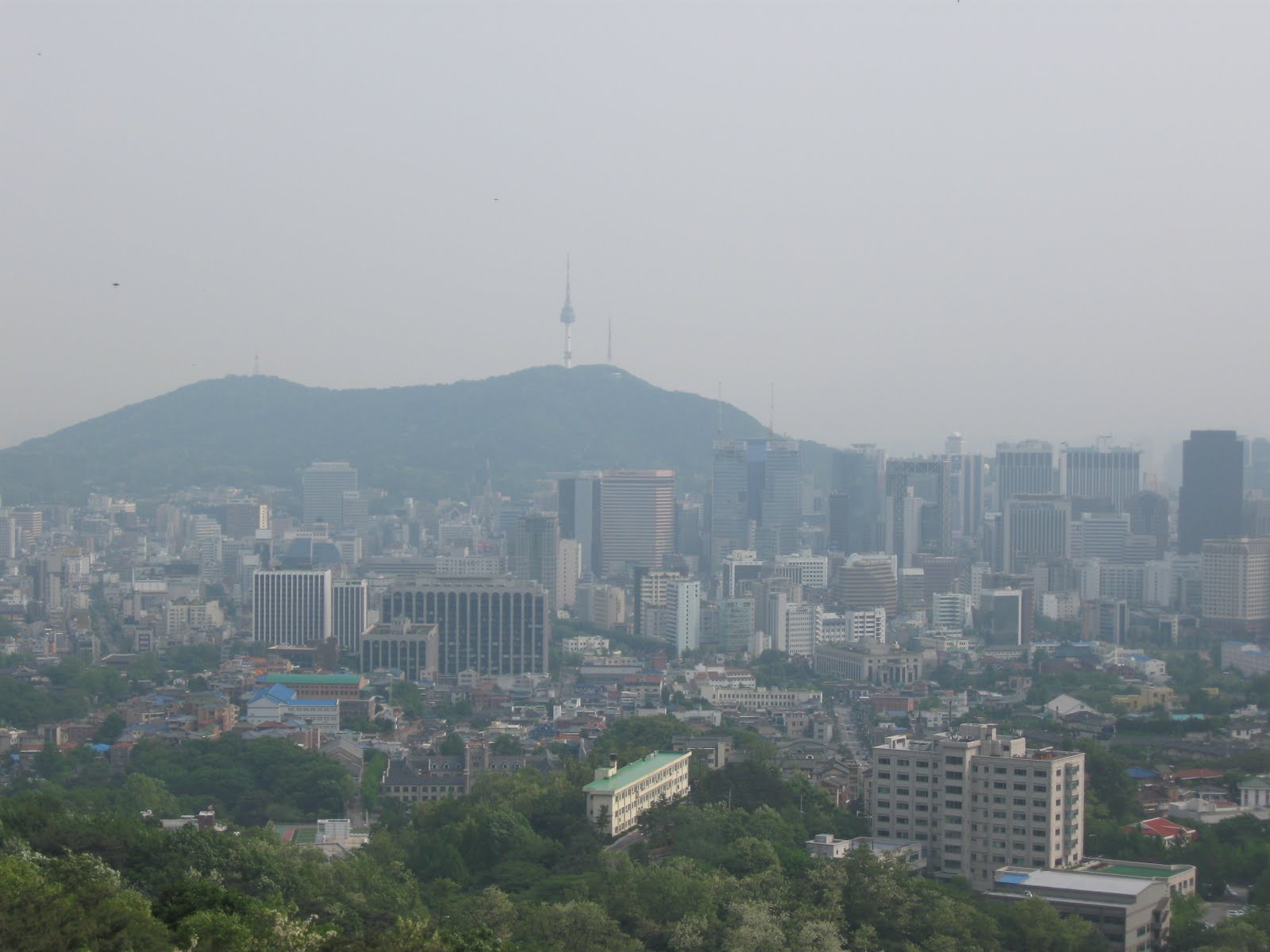
I was able to get my first shots of Seoul from above. This is downtown northern Seoul (below), and you can see Namsam Mountain (from an earlier post) on the left. I live south of that mountain, across the Han River in Gangnam, which has emerged as a second downtown. On the right is Gyeongbukgung, the palace from another previous post.


After hiking down the mountain, we set out to look for a neighborhood of traditional Korean homes in the Samcheong-dong, which is a neighborhood just south of the mountain we had hiked. After reading about these homes in a tourist magazine for expats, we assumed these homes would be a historical (it annoys me when people say an historical) tourist site. There was literally no one walking around in the first alcove of homes we came across, and it was obvious that people were still living in them. It felt awkward walking up to the homes, snapping pictures, and walking away. I was hoping that we wouldn't run into any of the owners the whole time we were in that area. We eventually found the more touristy, much larger neighborhood, but it was still just that, a neighborhood. Koreans wander the alleys, checking out homes that have been in tact for about 75-100 years, but that are, for the most part, still inhabited. Many of the homes had garages, and the homes had electricity and other modern conveniences. In the U.S., homes like these would be bought up by a historical society, or used as a tourist attraction, like Greenfield Village. It seemed very odd that someone's home could be a tourist attraction, but I enjoyed getting lost in the crooked alleys.


Hangang Park

Hanggang Park is a park about a mile or mile and a half north of where I live along the Han River. It was more of a wide-open space, as opposed to the wooded Samcheong Park. It provided a nice view of the southern side of Namsam Mountain, so hopefully you can get some feel for the geography of the city. Keep in mind that Seoul has a second downtown south of where I'm standing while taking the picture. I also got a shot of one of Seoul's bridges that has fountains shooting out into the river. I didn't get very close though, so the shot wasn't great (that's why I didn't post it). The bridge lights up at night, and it is supposedly quite a sight. It was very relaxing just to lay out a towel riverside and read a book for a hour or two.


Changdeokgung

Changdeokgung is another royal palace built by the Joseon that ruled Korea from about 1400 up to its surrender to the Japanese in 1910. Gyeongbukgung is the most expansive palace, and was initially the primary residence of the royal family. Then in the late 1500s the Japanese burned all of the palaces down, and Changdeokgung was the first to be rebuilt (there is kind of a recurring theme in Korean history of the Koreans building cool things and the Japanese burning them down). It then became the primary residence of the royal family until that last king capitulated. Even though it is not a spectacular as Gyeongbukgung, it is the most well-preserved, hence the only palace in Seoul that is a UNESCO World Heritage Site. Below is a shot of the main hall as well as a shot of its inside. The palace complex also includes a supposedly beautiful "Secret Garden," but it costs an extra 5,000 won (about $4-5), and you can only enter if accompanied by a tour guide. By the time we came to the garden, the last English tour had departed, so we decided to save the gardens for another day rather than pay for a tour in Korean.


Insa-dong

Insa-dong is a small, 2-3 street area in northern Seoul that features many traditional Korean souvenir shops. You can buy crafts, fans, art, or other less traditional, tacky souvenirs. The only thing I bought that day was food (surprise, surprise). The guys below on the right were very charismatic and made a delicious candy from honey and nuts. They began with a hardened block of honey, hollowed it out to look like a doughnut, then kept stretching it until it was thinner than strings. The honey wires were then wrapped around crushed nuts. After perusing the main street for a while, we decided that we needed to relax and enjoy some tea at one of Insa-dong's famous traditional tea shops. Our table overlooked the main stretch, allowing me to get some pictures from above.


I tried the delicious jujube tea (below on the right). I opted for iced tea because it was a rather hot day. The waitress was kind enough to to give us English menus, but some of the descriptions were rather interesting. Each drink included a description of the health benefits that that tea offered. Notice the benefit of "prevention getting fat." This would be a good time to bring up the term "Engrish," or as the Koreans call it, "Konglish." Basically, Engrish is a mistranslation (or in this case an all-too-literal one) that makes for some entertaining reading for English teachers living abroad. Sometimes the errors are with syntax, sometimes with spelling, or sometimes a sign just won't make sense. In this case, the translation also failed to tactfully explain the health benefit of that particular tea.


Saturday, May 22, 2010

Buddha's Birthday


We had this Friday off to honor Buddha's Birthday, a national holiday. We decided to visit a Buddhist temple to honor the occasion. After doing some research, we found that one of the more famous temples in Seoul was only a few stops down on the subway. The temple is called Bongeunsa, and we had seen it in passing on the way to a field trip with our kindergarten classes a month ago. The temple was founded in 794 AD, and is quite impressive. More and more buildings and halls were added throughout the years, but in 1939 a fire destroyed nearly all of complex. It has since been rebuilt and renovated. It consists of several buildings and worship halls, and a giant statue of Buddha. During the holiday, the temple was incredibly crowded and adorned with lanterns. Our Korean friends explained to us that if you wrote your name and address on a lantern and hung it up, then Buddha would bring good fortune to your family. Unfortunately, the cheapest ones cost 20,000 won (about $20). Instead, we opted to wait in line and pay 1,000 won to use a ladle pour water over a golden baby Buddha. This practice is symbolic of washing away bad Karma. After that we went inside the main temple, where we had to remove our shoes before entering. Bong-Hee, one of my Korean friends, showed me how to use the prayer mat to bow before a statue of Buddha three times. After that we continued to walk around the temple complex, taking in the beauty of the various buildings and decor. Finally, we ended our visit in front of a giant statue of Buddha, the largest such statue in Korea. I was a little disappointed to read that it only dates back to 1996, but the statue is still impressive.

Saturday, May 15, 2010

Children's Day, Parent's Day, and Teacher's Day

I have been extremely busy the past few weeks, thus have not had a chance to blog very much. In Korea, the month of May contains a string of holidays to honor various groups of people. First was Children's Day:

Children's Day

Children's Day is a national holiday, which means we did not have class on May 5th. Our school celebrated before hand by taking our kindergarten kids to The Wizard of Oz. The music was different, and the entire play was in Korean, so my job was to sit there and make sure that the kids behaved. The kids seemed to enjoy the show, and the performers came out after the show for a drum-line performance, which was pretty cool. Our afternoon kids had a speech contest, but because my kids are at such a low level, I typed out an outline for them. The speech was about themselves, so all they had to do was fill in the blanks writing what foods they liked, words that described them, etc. After the contest, they had some snacks that were prepared for them to eat.

As is so happened, Children's day coincided with Cinco de Mayo. So, since we had the day off, we headed to Itaewon (the foreigner's area in Seoul where the American military base is located and where several embassies are near) for some Mexican food and drinks. The restaurant we went to was overpriced (as so many foreign restaurants are), charging around 15,000-18,000 won (about $14-17) for a meal. The food was mediocre, but as was the case for St. Patrick's Day, the occaison was honored. It was our Korean friend, Ernest's, first time having Mexican food and he seemed to enjoy his fajitas. The restaurant even let us wear the sombrero they had during our meal.


Parent's Day


Parent's Day in Korea is the same weekend as Mother's Day in the US. We devoted one of our periods to making cards for their parents. The pictures tell the story:


Teacher's Day

Teacher's Day was yesterday, so many of my students' parents sent gifts for me. One parent sent a cake for me and my co-teachers to split, one sent Korean pastry-like treats, but the rest gave me skin products or beauty products. I got four bottles of after shave, skin moisturizers, shaving cream, shampoo, toning face mist, and scruffing lotion (I have no clue what the latter two are). I also got a bottle of fruits and passion body spray called "F/P Homme." I would make some sort of joke here, but I don't think anything I say at this point will be funnier than what you just read. I think men use cosmetics here more than they do in the US, but I was still shocked at the amount of beauty products I received. Tonight we are heading off to watch South Korea take on Ecuador in a soccer match. It should be a lot of fun. We bought some South Korean soccer jersies to wear to the game. I'll leave you with a chance to see my pile of skin products:

Tuesday, April 20, 2010

Excursions in Seoul

Gyeongbokgung

Gyeongbokgung was the royal palace of the Joseon Dynasty that ruled ancient Korea. It was originally built in 1395, but was burned down completely by the Japanese in 1592 (this is information from the brochure, not from memory). In 1867 the palace was rebuilt only to have the Japanese destroy it again in 1915. It's no wonder that the rivalry between the countries is so intense. It's rebuilding has been a long process and is still underway.


The entrance to the palace and a picture of us with a traditional Korean palace guard.


The King's Throne


This building is where the king had his throne, hence it was the primary building for political affairs. Here the king had meetings, met emissaries, and conducted ceremonies.


Gyeonghoeru Pavilion


This pavilion served as a banquet hall for the king.

Interesting Food...

After visiting the palace with our Korean friends, we stopped by a Korean market to sample some traditional Korean food. It was an interesting experience to say the least.


On the left is pig's feet. They were very fleshy and chewy, with little or no flavor. Most of what was edible (not bone) was skin. It was pretty disgusting, but I had what my mom would call a "no thank you serving." On the right is pig intestine stuffed with noodles, vegetables, and some meat. The flavor wasn't great, but it was much better than pigs feet. We also had a stir fry with cow lung and vegetables. Again, this was too chewy and fleshy for my liking.


Fortunately, we also ordered some more familiar Korean dishes as well. Noodle soup on the left and Dak Bokki (chewy rice cakes in a spicy, sweet sauce) on the right.


Cherry Blossoms and Yeouido

For about a 2-3 week period in April, cherry blossom trees bloom and line some of the streets in Seoul. We headed to and island in the Han River, Yeouido, in the center of the city where the trees are most prominent.


Yeouido Park


Yeouido Park is a large park in the center of Seoul.

The Korean National AssemblyThis is Korea's government building where their National Assembly meets.


Saturday, April 10, 2010

My Classes

I teach at a school called GDA Junior, a Hagwon for school-aged children. Hagwons are private learning academies that are very popular in South Korea. We offer immersion kindergarten in the morning and early afternoon, and supplemental English instruction in the afternoon to elementary and middle school children. I teach six different classes of kids throughout the course of the week. The school has supplied me with all the materials I need to teach. My homeroom kindergarten class is called Excellence (most of the kindergarten classes are named after Disney movies or abstract nouns). I begin each morning teaching them language arts. They are all Korean age 7 (in Korea when you are born you are 1, then everyone turns a year older on January First) meaning they would be considered 5 or 6 in America. It is their first year in "intensive" kindergarten, but most have had some prior exposure to the English language. Communicating was hard at first, but is becoming increasingly easy as the kids gain a better grasp of the language. They use a phonics book, which helps them learn letter sounds, and a reading collection, which features stories five pages long with about 3-5 words per page. Tough stuff. After teaching language arts to my kids, I teach language arts to my support class, while another teacher teaches my kids math, science, or social studies, depending on the day. My support class is called Dream. They are all the same age as the kids in Excellence, but have had one more year of English instruction. They can communicate very clearly and effectively, even if they don't quite have the grammar down. This class also has a reading collection, but there are usually a few sentences per page. The also have a Grammar and Writing Book, a Grammar and Writing Practice Book, a Practice Book, a Phonics Book, and a Writing Book (we use different books different days). This seems like a lot of work for kindergartners (and a ploy by publishers to sell more textbooks), but the kids are very capable and learn quickly.

After I teach my support class I have a half hour lunch break, then I return to my homeroom class for a period called "reinforcement." What I use this period for depends on the day. Some days my kids have gym or cooking (which have separate teachers), and I get a planning hour on those days. Other days, I teach my kids art or music. The art projects are provided for me by the school. I like art because the kids work quietly on their pictures or crafts for about 20 minutes. Last Monday they designed Easter eggs, but the most memorable art project was by far the first one, decorating cardboard boomerangs. Most of the kids couldn't speak English very well, but a quick demonstration got all of the kids (particularly a couple of the boys) riled up. After giving them 5-10 minutes of playing with their new art projects/lethal weapons, I had to transition to story time. Music usually consists of them listening to a song they have trouble understanding, me repeating each line very slowly 10-12 times and having them repeat each line after me, showing them the hand motions, and trying to sing the song 3-4 times through with the music. For some reason kids are always the most wild during music time. It could be because they are all standing or because they don't view it as "school time."

My afternoons are different depending on the day. Monday and Friday I teach a group of first graders from 2:40-4:20. This is probably my toughest class, because a hagwon is something that grade school children attend after their school day. It's a rough transition from kindergarten to first grade, especially when you have to attend English classes after school for almost two hours. On Wednesday, I teach a group of kindergartners (that stay after school) drama. I work with another American teacher who has a theater degree. She teaches them the acting part on Mondays, and I read the story with them. On Tuesdays and Thursdays I teach a class called reading lab, where I read stories with first grade kids, then do writing activities with them. There are three of the same kids from my Monday/Friday class in reading lab. I like this class more though because it's longer (2:40-4:40) and I have less material to cover. It allows me to play games and do more fun stuff with them. I invented a game called guess the animal (which is basically charades where animals are the only correct responses) and they seem to like it a lot. After reading lab I have a one hour break, then teach my final class of the day from 5:50-6:50. This is my only class with older kids, about 11 or 12 years old, but they are all at a very low level. For this class, I only have to teach them speaking and listening. I think this makes the class more fun and interactive.


I have some pictures of my homeroom class, but I haven't take pictures of any other classes so far.


Justin just celebrated his birthday


Rodin
This was the only picture I got of him somehow.


Ian


Harry


Henry


Rena


Eena


Brian
During play time the boys seem to be able to make guns out of just about anything. I tried the "no guns" thing, but it worked about as well as it did when I was in preschool. They are just too creative when it comes to complete destruction.


Christine


Dominic
Dominic was very elusive when I was taking pictures, but I think these two capture the essence of Dominic. He has the most trouble following our "No Running" rule.