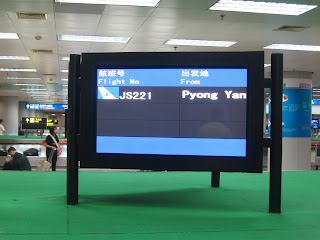
During September Koreans celebrate a holiday called Chuseok (Choo-sock), which is essentially their harvest holiday/Thanksgiving. I will have a separate post on Chuseok later. All you need to know for now is that it is a three day family holiday, and our school gave us an extra day off, which amounted to a six day weekend. I, along with four other teachers at my school, decided to take advantage of this and travel to Beijing. After buying a stick-it-to-the-Americans 195,000 won visa (Canadians pay 40,000) and boarding our plane we arrived in Beijing. I noticed an interesting arrival flight at the baggage claim area next to ours:
I doubt North Koreans are allowed to travel to any country besides China, and I wonder if it's only diplomats and state workers that are permitted to leave North Korea at all. I don't know; but it was very odd to see a flight arriving from Pyongyang. All of the luggage on the conveyor belt was blockish and colorless.
Before the trip we did some research and found that getting around by taxi in Beijing is a huge hassle for foreigners. We decided to hire a guide to help us see the sights. Since there were five people in our group, it only cost us about $60 each for three full days of his services. His name was Alvin, and he picked us up at the airport and took us to our hostel to drop off our bags. Here is a picture of Alexa, Antonio, and me with Alvin outside our hostel:
Summer Palace
We arrived around noon, so by the time we dropped our stuff off at the hostel we had time to do one major tourist attraction the first day. Alvin took us to the Summer Palace. The palace is actually more like an expansive park surrounding a lake with living quarters, gardens, and a massive Buddhist temple that dominates the landscape all on the northern shore. It was built by the Qing dynasty (China's last) in 1750 as the summer residence of the emperor. It was the most beautiful site we visited on the trip. Here are some of the best photos I took there:
Left: A view of the northeastern shore of the lake, which was completely covered in lotuses. Right: Alexa and me in the Imperial Gardens.
Left: A view of Longevity Hill, which contains the Palace's religious buildings, such as The Tower of the Fragrance of the Buddha (Right).
Left: A view of the lake from Longevity Hill Right: One of the many arched bridges in the palace
Left: Marble Boat Right: Sunset in the Summer Palace
I took a lot more video during this trip than I did in Japan. Some of it turned out okay, but the quality isn't great for any of my videos. The video below was taken from Longevity Hill and gives you an idea how big the palace is. The entire lake is actually artificial, as is Longevity Hill, which consists of the dirt drudged up while digging the lake.
We enjoyed our time with Alvin and would book him again, but his one flaw is that sometimes he was too thorough. We spent so much time in the living quarters that we didn't have time to see as much of the palace as we wanted to. Fortunately, on our last day we returned for a more leisurely stroll along the lake.
Tiananmen
We began the second day with a visit to Tiananmen Square, the political center of Communist China. The square contains government buildings, museums, monuments to the Chinese worker, and Chairman Mao's Mausoleum. Buildings from China's imperial past stand alongside massive, boxy communist halls. As the largest city square in the world, it has been the site of many rallies and political events throughout China's history. It is probably most known among Americans for the protests that took place there in 1989, which resulted in the massacre of 3,000 protesters. This famous picture was taken there.
This is a shot of Tian'an Men Gate, where Mao proclaimed the formation of the People's Republic of China. We went up in to the Gate to get a view of the square from above. Inside the gate is a small exhibit that explains the significance of many of the political rallies and events that have taken place in the square during the communist era. Noticeably absent from the exhibit was any reference to the year 1989. Seeing the square in person was like walking into a history textbook. It was otherworldly.
Left: The China National Museum, which was unfortunately closed while we were there. Right: The Great Hall of the People, home to China's legislature.
In the middle of the square is the Monument to People's Heroes (the large pillar/obelisk) with Mao's Mausoleum behind it. We went inside the Mausoleum and saw Mao's embalmed body. We only got a quick look because the guards were ushering people through quickly. Many of the locals (including Alvin) claim the body is wax, but it was hard for us to tell. Below is a panoramic video of the square that captures what a single picture could not.
Forbidden City
Just north of Tiananmen Square is the Forbidden City, an absolutely massive complex of halls, gates, courtyards, and a garden. Built in 1420 and served as the emperor's residence and seat of the Imperial Court until 1912. Every building along the north-south axis could compete for the most majestic structure I have ever seen.
Shots from in front of (left) and behind (right) the Meridian Gate, the entrance to the Forbidden City.
The city (and it's right to call it a city) consists of an outer court which was the administrative and ceremonial center of the palace, and an inner court, which was for the emperor and his family. Only one-third of the palace is open to the public, but Alvin showed us the vast majority of what was open in the five hours we spent there.
Perhaps the most impressive structure is the Hall of Supreme Harmony (above) which was used for ceremonies such as the crowning of a new emperor.
If you step off the main strip (the north-south axis) you can wander through small gates courtyards, and a labyrinth of halls like the ones above. You will also find exhibits on how the imperial family lived, which contain many authentic artifacts.
After spending several hours at the palace, we headed to Jing Shan Park, which overlooks the Forbidden City and helps you appreciate the enormity and complexity of the entire palace grounds.
Below is the pavilion in the park that we hiked up to. This is the only picture that can really do justice to the scope of the Forbidden City; even from above I could not fit it all on my camera:
We finished our second day with a Peking Duck dinner, but I will provide details about all the meals we ate in a future post. That's all for now, but I will have two more posts on China coming shortly.
This was my first year without a long summer vacation. Sure, I had summer jobs in college and high school, but for the most part, summer was a long mental break. This year I worked straight through the summer, with only a one week vacation during which I visited Japan (see previous posts). Koreans don't even have a summer holiday that results in a long weekend. As a former swimmer, lifeguard, and swimming coach, I'm used to spending the vast majority of my summers poolside. I'm also used to escaping up north to my grandma's cottage in Caseville for a couple long weekends of relaxing on the beach and reading. Despite spending nearly all of my summer indoors, I did find time for a couple short weekend trips. The first was to Boryeong for the infamous Mudfest. The second was to Busan, a mountainous coastal city and the second largest city in Korea.
Boryeong Mudfest
The Boryeong Mudfest is exactly what it sounds like: a huge party on the beach where everyone covers themselves in mud and has a great time. During the week it's mostly Koreans, but on the weekends English teachers and American GIs converge on the small coastal town to take part in the festivities. This was my first chance to get out of the Seoul metropolitan area, and my first chance to swim all year. Boryeong has some nice beaches, especially when the tide is low. The waves were high, so simply swimming in the Yellow Sea was a lot of fun. Here are a couple shots of the beaches:
We attended Mudfest through a trip put together by an English teacher recruiting agency. In hindsight this was not a good idea. They overcharged us, and gave us a room that allegedly sleeps four people. It consisted of one double bed. Luckily there were only three of us, not four, but we still barely fit into the bed. We arrived in Boryeong late at night on Friday because the bus didn't leave until 9 or 10 PM. After arriving, we picked up some refreshments and some small fireworks (sparklers and some small bottle rockets) and headed to the beach. This served as our three-weeks-too-late 4th of July celebration.
The following morning after a samgyeopsal breakfast/brunch we headed to the beach. There are inflatable pools filled with mud, giant inflatable mudslides, mudpits, and even a jail that you can enter and be hosed down with mud. Some of the mud pits were pretty violent, particularly the ones populated by American soldiers. For the most part, everyone just tackled everyone, though I got into one or two one on one wrestling matches. The pits below were some of the less crowded ones. There was on pit that had over 30 people in in at any given time. Due to being covered in mud it was very difficult to take pictures. These pics are courtesy of Alexa, who dried her hands off from time to time to snap some photos.
Left: In the mud pit. Right: A mudslide down a hill and on to the beach.
The picture above on the left is me covered in mud, and the one on the right is of a wrestling match. Antonio and I enjoyed the opportunity to release our primal instincts and get into a few scuffles. I don't think Alexa took advantage of this opportunity...she preferred the beachside mud spa.
Another drawback to going through the agency was that we had to leave by noon on Sunday, so we basically only had one day of mud-related activities. All in all it was a lot of fun, but could have been done at a cheaper cost.
Busan
The thriving coastal city of Busan is the second largest city in Korea, and by some measurements, the third largest port in the world. It is famous in Korea for its beaches, so for the last weekend in August, Alexa and I decided to visit and enjoy one last weekend of summer fun. Busan is a very mountainous city of 4 million people, and it seems as if canals of buildings and roads connect massive islands of mountains. Given the spread out nature of the city, we knew it was not going to be possible to "see Busan" in the two days we had. We prioritized and decided to spend most of our time relaxing at the beach, as this was the last weekend of summer and we had yet to unwind with a weekend in the sun (I wouldn't call Mudfest relaxing...). I will have to go back in order to see some of the sights we missed.
Beaches
Given all the hype I had heard from Koreans about the beaches of Busan, I have to say I was a little bit disappointed on the whole. There are three main strips of beach in Busan, all between a half mile and a mile long. The first we went to was the famous Haeundae Beach. Part of the reason we waited so long to come to Busan is that in late July and early August Haeundae Beach often looks like this. It was pretty overcast, and most Koreans had already had vacation, so we were lucky that the beach was not that crowded. The disappointment began when I went in for a swim. In Boryeong we were allowed to swim freely, provided that we stayed inside the buoys. This was not the case in Busan. At Haeundae the waters were pretty rough, with large waves crashing into shore, but any time you ventured out past your knees, the whistles of angry lifeguards descended upon you from all around. I was able to wade all of about five yards offshore before being whistled. Some of bigger waves splashed my chest, but that was about all I could hope for. Koreans are not known for their swimming prowess, so that combined with mildly rough waters combined for a disappointing swimming experience. Here are some photos of the beach:
After being disappointed with Haeundae, we decided to try our luck with Seongjong Beach. This beach was much calmer and much shallower, so you could venture out farther than at Haeundae. Unfortunately, being farther out didn't matter much because of the shallow nature of the beach. Before I could wade out to my knees, I was whistled once more. This experience was comparable to swimming in a kiddie pool where someone is splashing. Notice that many Koreans don't go shirtless at the beach. The vast majority of Koreans swim in T shirts and shorts. Songjeong Beach:
After a frustrating Saturday of swimming, on Sunday we headed to Gwangalli Beach. Gwangalli is known for the cafes and nightlife surrounding it, so when we went just after lunch time, it was not crowded at all. After an overpriced but decent pizza in a beachside cafe, we headed to the beach. The beach looks out at the "Diamond Bridge," which is supposedly very beautiful at night. The waters at Gwangalli dropped off quickly, so if I ventured 5-10 yards off shore I was up to my chest. This was the swimming experience I wanted and had missed out on all summer. It was also a much nicer day on Sunday, so we spent a good chunk of time alternating between swimming and reading in the sand.
Yonggungsa
Despite being beach bums for most of the weekend, we did make time to visit one temple on Saturday: Yonggungsa, or in English, the Dragon Palace Temple. Despite being a pretty standard Korean temple in terms of scale and architecture, Yonggungsa is set apart from other temples due to its seaside location in the cliffs. I didn't pick up on as much of the history of the temple as I wanted to though. There were no broshures and the English sign about the temple was in such broken English that it was hard to follow. What I did gather is that the temple was originally built in the 14th Century, but the main hall was rebuilt in 1970. Also, most Korean temples are built in the mountains, but this temple was built seaside because of its emphasis on dragons. In European culture, dragons are typically associated with fire, but in Asian cultures they are typically associated with water. The dragon motif was all over the temple. Statues, carvings, pictures. Here are a couple examples:
Here are some shots of the temple itself. One is from a cliff jutting out right next to it, and one is from the top of the cliff looking out along the Pacific coast.
It was also a lot of fun watching the water smash into the rocky cliffs. This video doesn't do it justice, but it gives you an idea of what it was like:
Aerial View of Busan
Before heading back to Soeul, we stopped by a mountaintop park, right up the hill from our hotel. Atop the mountain was the Busan Tower, a great point from which to view the sea ports and mountains enveloped in clouds.
All in all it was a fun trip, despite some disappoiting beaches. I am also excited that Michigan football season has started. I pulled an all-nighter to watch the first game online with Antonio last night. We looked good, but I am tempering my expectations after what happened last year.
Anime is everywhere in Japan: comic books, TV, billboards, and toys. This was something that I expected, however I did not expect to see toys like the one below on the left. I saw it in a touristy gift shop in the observatory of the Tokyo Metropolitan Government Building (the building we used to see Tokyo from above). It seems like Japan uses scantily clad cartoon women in advertising the way we in the US use actual scantily clad women in advertising. There were also naughty magazines (some cartoon, some not) on most magazine stands, though we never encountered the infamous panty vending machines.
9.) Blond Asians
This is my excuse to comment on the differences between Korea and Japan. On the very first day in Tokyo, I couldn't help but notice that there were a lot of Japanese people who had died their hair blond or red. This was particularly true in the youth-centered areas around Shibuya and Harajuku. These neighborhoods are where trendy teens and twenty somethings go to be seen. The people above were nice enough to let us take photos with them.
Both the Koreans and the Japanese are extremely well-dressed. In Korean society appearance is very important, particularly for women. They often won't go out in public without wearing what I would consider to be nice clothes. There are nice Western designer stores in Korea that I had never heard of back home. The Japanese, while still style conscious, are a little bit edgier. They take more risks with fashion and dress less conservatively. I'm sure the clothes they are wearing are designer brand and in line with the latest fashions of the day, but unlike most Korean outfits, they look ridiculous. In either Korea or Japan I'm a little bit out of place wearing a plain T-shirt in public.
The differences in style could be a metaphor for the differences in society. Korea is very Westernized in terms of its economy, but still much more conservative than the US on the whole due to the strong influence of Confucianism. Japan tends to be more liberal, whether its fashion, hair style, or sex (see #10).
8.) Green Tea
Japan is also famous for tea, so trying a cup of traditional tea was a goal of mine on the trip. As mentioned in the earlier post, the highs throughout the course of our trip were consistently between 90 and 95 degrees (I still can't think in metric), which never really put me in the mood for hot tea. Luckily, on our last day of the trip, Alexa and I stumbled across a tea house surrounded by a lake in the Detached Palace Garden that offered iced green tea. Green tea isn't Alexa's favorite (she describes it as "earthy" which is her family's version of the word "interesting" when it comes to describing the taste of something you don't like), but we were in Japan, so we headed inside for a cup. It came with a small traditional pastry and instructions on how to drink the tea. Green tea isn't my favorite either, but the iced tea hit the spot on that occasion, and allows me to say I've had traditional Japanese tea.
7.) Trains
Trains are the way to get around Japan. The public transportation system there is like nothing I've ever seen. Of course it puts the US to shame, but it also surpasses Europe in convenience, speed, and punctuality. Before leaving Korea, we bought a rail pass through a travel agent which gave us access to all of the lines and all except one of the trains in Japan for one week. It wasn't cheap (about 390,000 won or $330), but it is much more cost effective and convenient than buying individual tickets to each city. All we had to do at each rail station was flash our pass and walk by. The trains arrive when they say they are going to arrive and leave when they say they are going to leave. I'm used to Amtrak, where you can plan on being at least 15 minutes late to your destination. Bullet trains connect most of the major cities. These trains can complete the 420+ mile journey from Hiroshima to Tokyo in about four hours. Do the math. The average speed is 105 MPH, including stops.
In addition to having access to all of the bullet trains, we had access to each city's regional network of rails, but not the subways. For the most part though, the regional railways served as a subway, linking different neighborhoods and suburbs. We only had to use the subway on the back end of the trip in Tokyo when our seven day pass had expired.
6.) Hustle and Bustle
One of the most fun parts of Japan is the urban hustle and bustle that is the yin to Kyoto's yang. We experienced this most our first night in Tokyo, when we visited Shibuya at night. Granted I still have never been to New York City, but Chicago and LA have nothing like this, two story TV screens on every corner, neon lights, people heading in all directions. The video below is of the famous "Scramble Crossing" outside Shibuya Station, one of the busiest train stations in the world. More people cross the street at a given crossing than any other intersection in the world.
I would have liked to have had more time to enjoy the nightlife of the modern Tokyo, but time just didn't allow it. The first night we called it quits early because we were exhausted from getting up at 6 AM for our flight. When we got back to Tokyo, we had to get up early again the next morning for the fish market, and the nightlife around our hostel didn't compare to Shibuya or Shinjuku (where we stayed the first time in Tokyo). That said, I'm glad I at least got a small taste of the modern Japan.
5.) Tame Deer
Two of the locations we visited on our trip featured tame deer that you can feed, Nara and Miyajima. Our tour guide in Nara explained to us that according to Shinto beliefs a god appeared riding on the back of a deer in the virgin forests of Nara. After this point, deer were considered sacred and killing one became a major crime. In fact, for a period it was considered worse to kill a deer than to kill a human. Over time, the deer became tame because they didn't have anything to worry about. Apparently the deer are pretty aggressive in terms of going after what they want. Our guide told us to turn our palms out and show the deer that we didn't have anymore food once we were done feeding them. Even after doing that, I had deer trying to nibble at the paper wrapper their food came in that I had placed in my pocket. Below is a humorous sign warning tourists of the potential dangers that the deer pose.
Here is a shot of me feeding the a deer.
I tried to capture this deer nibbling at the souvenirs being displayed at this shop. By the time I got my camera out I captured him being shooed away by the owner instead.
4.) Toilets (to my grandparents out there reading, you may want to skip this one)
Open any travel guide on Japan and the first few sentences will read something like this: "Japan is a country of contrasts. The modern and the ancient, the fast-paced and the serene, the old and the new, the traditional and the high tech, etc." The toilets are a microcosm of these contrasts inherent in modern Japanese society. Traditional, or Japanese style, toilets are like the ones pictured below:
I had no problem with these when doing a number 1; it was just like a urinal that was on the floor instead of the wall. The only problem is that these toilets replace actual toilets, not urinals, and do so in both men's and women's restrooms. If you are a female or doing a number 2, you are supposed to squat over the toilet and let it fly. Shockingly, Alexa was not fond of these toilets.
Next up, the space-age toilets of the future:
These toilets come with built-in bidets, deodorizers, spray, and play a loud flushing noise. This toilet was at our hostel in Kyoto. After a couple times handling your business as usual, you start to get curious with all of the buttons sitting next to you. The most easy button to experiment with was the "flushing sound". It simply makes a loud flushing noise without actually flushing the toilet. Kind of pointless if you ask me. I was a little bit nervous to try the "spray" button, but curiosity finally overtook me, and the next thing I knew, my butt was being sprayed. For some reason this surprised me even though I had just pressed the button with a picture of a butt being sprayed with water. I immediately pressed the "stop" button. But, ever the more curious, I wanted to find out how this mysterious butt spray worked. I pressed it one more time and this time sat up slightly so I could look at what was happening below me. A thin, white water canon emerged from the back of the toilet under the rim and begin spraying once more. I don't think this will catch on in the US anytime soon.
A highly informative sign above the toilet on the train instructing male travelers how to use a toilet seat.
3.) Sumurai
Starting in about the 9th Century, a land owning, farmer-warrior class began to emerge and gradually began to challenge the emperor's hegemony. These warriors became known as the samurai, and they ruled Japan during its feudal period, which lasted from roughly the 1100s until the 1860s. The leader/dictator was known as the shogun, and the samurai were the Eastern equivalent of a lord/knight combination. The emperor was largely a figurehead during this time period. The various samurai clans went through periods of infighting and cooperation, on and off, for the entirety of their rule, with shogunate hereditary dynasties switching a few times. The samurai practiced Zen Buddhism and emphasized austerity, fidelity, and a warrior culture. They built the majority of Japanese castles, including Himeji. Outside Himeji we found a shop where you could try on armor and wield swords. Antonio besmirched my honor, so I had to defend it. Antonio ended up buying a sword as a souvenir on the trip. He tried to convince me to buy one (they were only about $75-100 for a real sword), but I was convinced it would be too much of a hassle. Upon arriving back in Seoul at the baggage claim, the box containing his sword was wrapped in yellow tape informing customs to check it out. They asked him why he was bringing a sword into their country. Antonio was tempted to say, "Oh, you know, for stabbing," but decided against it and said it was a souvenir. They confiscated his sword until he gets a permit from the Korean police department.
2.) Shintoism and Buddhism
The two major religions of Japan are Shintoism and Buddhism, and the most interesting thing about Japanese religion is that these two are not mutually exclusive. Most Japanese practice both. In fact, Shinto spiritual figures tend to preside over weddings, whereas Buddhist spiritual leaders tend to preside over funerals (due to their belief in reincarnation). There has been little conflict between the religions, a remarkable contrast to the history of Europe and the Middle East. Throughout history the Japanese still found reasons to kill each other, as well as their enemies, they just never cloaked it in religious dogma. Most of you are probably familiar with Buddhism, a faith that originated in India and then spread to China, Korea, and eventually Japan. Buddhism emphasizes detachment from your desires through meditation. The most common Buddhist symbols of Japan were statues of Buddha and pagodas, which differ dramatically in each society in which Buddhism took root.
Shintoism is Japan's native religion, and was explained to us by our Nara tour guide as an animist belief system that worships the various aspects of nature. The most common Shinto symbol is the torii gates. She informed us that these gates originated as a resting place for crows, who are seen by the followers of Shinto as messengers from the gods.
1.) Food
No surprise here for those that know me. Food finishes number one. I'll briefly describe dish by dish some of the foods I liked most, then talk about other interesting food-related experiences.
Noodles
Japanese noodles are very tasty and consist of two types: soba and udon. Soba noodles are dark noodles made from buckwheat. Udon noodles are thicker and made from flour. One common soba noodle dish I liked features cold noodles dipped in a soy-based sauce with wasabi. You dip the noodles in the sauce, then eat them. There is an example of this dish below that is nearly gone. Next to that is a udon noodle curry.
Shabu Shabu
Shabu shabu is an onomatopoetic phrase that in English would be "swish swish". Is is a pot of boiling both that you throw veggies into. Then, holding your meat with chopsticks, you dip it in until it cooks. We found an all-you-can-eat shabu shabu place. Antonio each polished off 6 trays of meat (3 beef, 3 pork). Alexa ate four, which isn't too shabby either. After the meat is cooked there are delicious sauces to dip it in.
Okonomiyaki (o-kon-o-mee-yak-i)
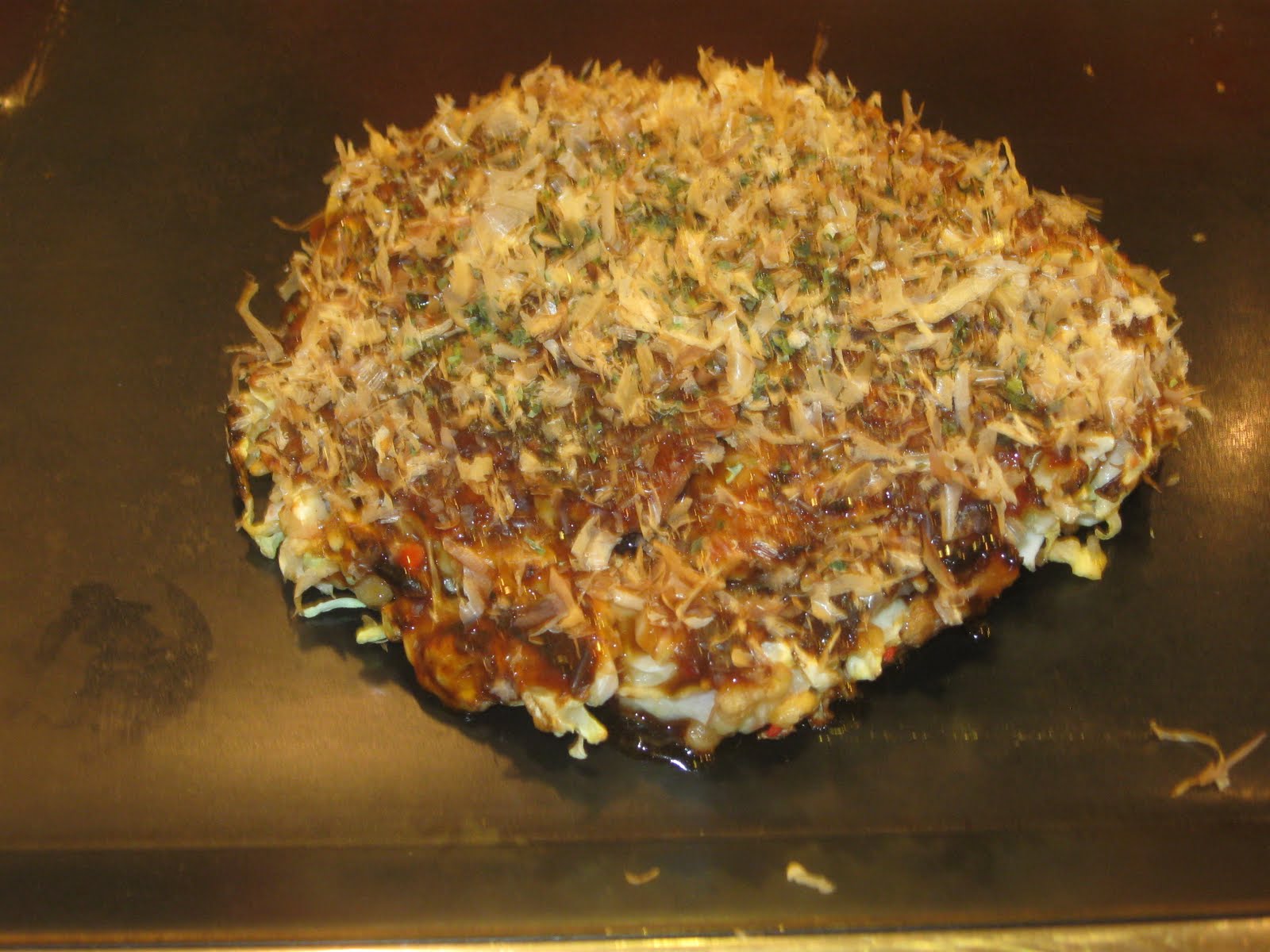
This was hands down my favorite non-Kobe beef dish of the trip. Okonomiyaki is a Japanese pancake made from batter, cabbage, pork, and delicious sauce, and sometimes noodles, sprouts, egg, and ginger. There are two types, Osaka style and Hiroshima style, both named after the city in which they originated. Osaka style is prepared by mixing all the ingredients with the batter, then frying it. Hiroshima style is prepared by cooking each ingredient separately, then layering it. We had the Osaka style (below left) in Kyoto at a small hole-in-the-wall restaurant we stumbled into. We liked it so much that we ate there the next day too. We had Hiroshima style (below right) in Hiroshima at this massive food court dedicated entirely to okonomiyaki. It was cooked in front of us by a very charismatic chef. I preferred Osaka style because I liked the cabbage more when it was covered in pancake batter.
Another fun food experience was ordering rice bowls via vending machine. The bowls all come with veggies, rice, and meat. Not knowing what anything said, I basically put my money in and punched the button next to the picture that looked best. A few minutes later, a waiter brought it out to us. I liked Antonio and Alexa's dish better than my own, but it was still fun.
The final culinary discovery (or in this case rediscovery) of the trip was that of a long-lost childhood favorite: Koala Yummies. During our trip we saved money by often eating small breakfasts and snacks that we purchased at marts to get us through the day until dinner. At nearly every mart was that beautiful, green, hexagonal box of chocolaty koala deliciousness. Back sometime in the mid-nineties, Kola Yummies (thin cookie wafers in the shape of koala bears stuffed with fudge) took the US by storm. They were advertised on TV and all over the grocery stores. My mom refused to buy them on the obviously erroneous premise that they had absolutely no redeeming nutritional value. That only made my brothers and me covet them even more. It was always a treat whenever we could get our hands on them. Then, after only about a year or two on the market, Koala Yummies disappeared forever. The nostalgic treat of my childhood was lost....or so I thought. In Japan they were everywhere, and I probably ate six or seven packs of them on the trip. I will definitely be on the lookout for them here now, as they are made by Lotte, a Korean company.
That's all for my posts on Japan. If you are still hungry for more check out Alexa's blog or check out all of my photo albums on Facebook: