Monday, May 9, 2011

Goodbye, Hello

Once again it has been awhile since my last post. I have been teaching at my new school, Bambini, for almost three months now, and things are finally starting to settle down. I'll start this post with the end of my year teaching at GDA, then transition to my new class, Olive Class.


Excellence Class Graduation

Schools in Korea start in March, so at the end of February we had our graduation at GDA so that the kids could go on to elementary school. Each class had their own graduation ceremony, and since my class was the largest, I had mine in the gym. I began with the ceremony with a short speech about the school year. After that, each kid gave a speech about a topic that they had learned about in either science or social studies throughout the course of the year. The students wrote the speeches by themselves (O.K., there was one kid I had to "suggest" sentences to), then I corrected them. Remember, at the beginning of the year most of these kids couldn't understand what I was saying. Each speech was about 7-8 sentences long, except Justin's. He went on and on about where Seismosaurus lived and what it ate (this is the same kid who taught me that the capital of Liechtenstein is Vaduz). After the speeches I handed out diplomas and my gift to the kids (a copy of Doctor Seuss' Oh, The Places You'll Go). Unfortunately, I was running the ceremony, so I couldn't get many pictures during it. At the end there was time for a group photo, so I gave my camera to my supervisor who took a group shot for me.


I was able to take pictures after the ceremony, where I snapped one of Justin (above left). Rena's mother sent me an e-mail with a couple pictures she had taken of me and her daughter (above right). Here is the e-mail she sent me:

Dear Eric teacher,

Hello. I'm Rena's mom.^^
I wanted to write e-mail to you,
but I was very busy with the care of Rena's new school days.
How is your new place?
Rena adapts to an elementary school very well,
but she doesn't like a new English institute.
She said, "Eric teacher is much better than Hannah teacher.
I miss GDA and Eric teacher."

I am so glad that my daughter met a teacher like you.
You majored in education and love children.
Besides, you look like the God of Greek mythology.^^
I thought that Rena was very lucky.
After GDA graduation ceremony,
I was impressed by your letter and present.
I can feel your hearty mind and the book has a wonderful story.
Rena said, "Eric teacher read this book at a library.
This book is very interesting and I want to have this book.
How does Eric teacher know my mind?"^-^

Rena & I will visit my cousin in U.S. during the summer vacation.
She will join in Bible camp
and we will have a tour round the amusement park in California.
I hope Rena will have an interest in English again through this trip to U.S.

I appreciate your teaching and caring.
I wish you wonderful days!


Sincerely,

Rena's mom

Excellence Class lived up to their name in every possible way. Teaching them for a year was an extremely rewarding experience, and I continue to miss each and every one of them.

Post Graduation Mayhem

While I failed to capture the bittersweet nostalgia of the graduation ceremony, I did an excellent job of capturing the post-graduation mayhem that ensued. This was entirely appropriate, as it was probably a better representation of what the year was like anyway.


Harry always kept me laughing. He managed to completely invert himself in the play place (above left) and elephants are his favorite animal (below right).


Hello Olive Class

Yes, my new class is called Olive Class, and I don't even like olives. All of the classes at my new school are named after trees (maple, cherry, cedar, etc.). At first I didn't think trees compared to honorific abstract nouns like Excellence, Dream, and Courage, but Olive has started to grow on me. The kids each have an olive with their name on it velcroed to a felt tree on a wall in the classroom. If they have enough stars at the end of the day (awarded for good behavior), they get a sticker to put on their olive. Twenty stickers earns a prize. It is a class of Korean-age 6 year olds, which, to reiterate, is 4 or 5 in the Western world. Their English speaking abilities are actually much better than Excellence's were at the beginning of last year. All of them have had at least one year of English education prior to this year. Their reading abilities vary quite a bit. A few kids in my partner teacher's class (Pine) can't read at all, while a couple kids in each class can read most words they encounter. The Korean education system is very intense from day one (and it is thoroughly reinforced by a "Tiger Mother" in each and every house), so it is very important that the five year olds that I teach will be able to read and write in English by the time I'm done.

And now to introduce the kids. Behold, Olive Class:


Lynn (left) and James (right).


Emma (left) and Jennifer (right).


Junho (left) and Sooah (right).


Dorothy (left) and Dongha (right)


Nate (left) and Michelle (right). You can see the olive tree next to Nate.

Olive Class had a very tough act to follow, but they are rising to the occasion. While they are a year younger, their English abilities are a year or two more advanced than Excellence's were at this time. Thus, I would say that their attention spans are roughly equal. The same cannot be said for Pine Class, whose attention spans are non-existent for the most part. So far the fundamental difference between 6 year olds and 7 year olds is the ability to hold on to the pencil. While 7 year olds certainly have not acquired the skills of seasoned pencil-holding veterans, they clearly are more than mere amateurs. A 6 year old classroom, on the other hand, is a cacophonous symphony of pencils hitting the tile floor.

First Field Trip

We've actually been on three field trips, but I only brought my camera along for the first one. Our first field trip was to a fire department. The kids got to put on firefighting gear, spray water guns, and go down a giant slide-like chute.


Next weekend is a long one due to a national holiday on Monday. I will spend the three days visiting Gyeongju, a city in southern Korea that served as the capital of the ancient Silla Dynasty. It's a historic city with lots to do, so when I finally get around to my next post, I will have a lot to say.

Saturday, February 12, 2011

Christmas in Bali and the Gilis

Christmas in Paradise

After spending our first two vacations in sightseeing mode, Antonio, Alexa, and I decided to switch gears for winter vacation. We decided that we wanted to spend some time beach bumming, and, after considering a few different options, landed on Bali. Bali is a small island in Indonesia known for beaches, parties, and surfers, but also temples and rice terraces. Our flight departed Christmas Eve Day.

Indonesia is like no other country I have visited so far. I'm sure there are parts of China that are comparable, but thus far I have only been to Beijing (and mostly the touristy part of Beijing at that). The airport was the smallest I have been to and featured Balinese Hindu architecture. After getting through customs, we booked an airport taxis to ensure that we would not be ripped off. The ride to our hotel was illuminating. We drove through Kuta, which is like a maze of concrete development (for the tourists) and shanties (for many of the locals). Traffic is terrible during certain hours, but mostly because there is no real planning that went into the construction of the small city. The most common form of transportation for the Balinese was a moped. Often, we spotted entire families on the mopeds or women driving with babies strapped to their backs.

After we dropped off our stuff at the hotel, we headed to the beach to catch the sunset. This proved to be a wise decision, as it was the only sunset we saw the whole trip. It was "rainy season" in Indonesia, which means that the late afternoon and evening is mostly overcast, and that there is usually 1-2 hours of rain a day. After snapping a few pictures, we headed off for Christmas Eve dinner at a Balinese restaurant. It was decorated with wreaths and small Christmas trees, and the waiters all wore Santa hats or reindeer ears. This looked extremely out of place and tacky, but it did not detract from the meal. We split satay, one of Indonesia's most famous dishes, for an appetizer. It consists of roasted chicken skewers covered and/or dipped in peanut sauce. I had a scrumptious pork dish for my main course. Indonesia is a Muslim country, but Bali is a Hindu island (for reasons I'll explain later), so pork is actually very common.


We headed back to our hotel, relaxed for a while, then went to sleep. The next day we were off to the Gili Islands.

Gilis

The Gili Islands are three small islands off the coast of Lombok (the closest major island east of Bali). Gili means "island," so Gili Islands is redundant. The islands are known for pristine beaches, coral reefs, and a more laid back atmosphere than Bali. There are no cars or paved roads on any of the islands, so if you want to get around you have to flag down a pony and buggy driver. We stayed on Gili Trawangan, the largest and most populated of the three. When we arrived the skies were clear and sunny, the water blue, and the sand white. Our first day was the best day for beach bumming, as it was the only day where the rain was held off all day. We relaxed at the beach for a while, reading, sunbathing, and swimming in the warm water.


After relaxing on the beach, we decided to walk around the entire island and explore. Most of the touristy hotels and restaurants are on the east side of the island, with the some laid back bungalows in the north. The west side is also mostly beach, but the beach is smaller and not as nice as the east. The center and south of the island have countless palm plantations, which I assume are for extracting palm oil (the most common oil in the world). On our journey around the island we came across a beach side restaurant offering a private sunset BBQ. This seemed like the closest thing to a Christmas dinner that we would find, so we made reservations.

After our stroll around the island, we headed back to the restaurant. We decided to take a shortcut through the middle of the island to save time. The map wasn't accurate, so our shortcut wound up being a detour because we got lost. But the middle of the island gives you a glimpse into what life is like for many of the locals, who despite the hoards of tourists remain impoverished. Many of them live in slum-like conditions with chickens roaming around their plots. Some were lucky enough to have a goat. While there are hints of a middle class, many of the people lived in homes like the one below.


As our detour passed by the homes of the locals, I felt guilty. The dirt paths we traversed went right up to some of their houses, and it was apparent that they did not have much. Despite their poverty though, the locals were some of the friendliest people out there. Many waved at us or shouted out English phrases that they had learned. If I were in their shoes, I might come to resent the hoards of tourists who come to my island to indulge. The people seemed very welcoming though and were surprised to see tourists near their homes (most visitors stay along the coast). The glimpse into what life was really like on the islands was truly fascinating.

After our brief detour, we arrived at the restaurant, which was more like a kitchen with seating on the beach. They had fired up a grill for us and quickly brought us our food and some sangria. The dinner included burger patties, potatoes, tuna steaks, chicken satay, and a few other dishes that I have since forgotten. We grilled the food ourselves and enjoyed our beach side Christmas dinner.

Snorkeling

The highlight of the trip to the Gilis was the snorkeling trip we took the day after our arrival. The rain held off for the morning and early afternoon, giving us a full day to enjoy the reefs and marine life. For a small price we were herded onto a glass bottom boat and packed shoulder to shoulder next to 25-30 fellow snorkelers. The crowded boat was another example of something that we fret about in the west but the developing world doesn't think twice about. They need the money, so they pack the boats like sardine cans without worrying about class action lawsuits. We "splurged" and bought a $30 waterproof disposable camera, but it was the best purchase of the entire trip. The pictures we took tell the story better than I could.


Antonio managed to see three turtles, but Alexa and I only saw one. Luckily, I hand the camera ready and captured it with a great shot.


After two more increasingly rainy days spent beach bumming, enjoying happy hours under pavilions during torrential downpours, and nursing stomachaches, we headed back to Bali. Now would be a good time to explain how we got from Bali to the Gilis and back. There were two options. A slow boat that took 8 hours, or a fast boat that took 2 hours. Each provided transportation from and to your hotel on Bali. We opted to pay a little more for the fast boat to save time. On the way there it was smooth sailing and sunny skies. The way back was another story. A storm had just passed and the waters were rough.

The ride began nicely enough, and I enjoyed one of the two complementary croissants that the boat service provided. Once we left the relatively calm waters surrounding the island, the waves started to get bigger. It started out like an amusement park ride. Antonio and I were laughing and having a grand ol' time. After about 15 minutes, however, it was like an amusement park ride that had been going for, well, 15 minutes. Then the waves started to get bigger and it was like an amusement park ride that you wished someone would turn off. The guy in the row next to me puked. I tried to fight it off for as long as I could, but with each wave my stomach dropped further. After opening the window didn't help, I muttered that I needed a bag to Alexa. She flagged down the staff, and I got one just in time. Alexa isn't comfortable on the open water, so after a few rough patches she was the first to put on her life vest. After several thuds which featured the boat smacking down on the water after hitting a big wave and one wave that went over the boat, most of us had joined her.

Bali
Most of our remaining four days in Bali were spent alternating between the pool and the beach at our resort (we found a guy on Craigslist who lives in one of the rooms and rents out the other at heavily discounted rates). There's not much to describe there, so I'll devote most of the remainder of this post to the one day we hired a driver to see some sights in the island's interior.

Falls

The first stop on our private tour was at Tegenungan Falls in the jungle. It's not the most famous waterfall on the island, but it fit nicely into our itinerary.


Monkey Forest

After a brief stop at the falls, we headed to Ubud, a small artsy village surrounded by a sea of rice paddies and jungle. The main attraction was the monkey forest, a jungle temple swarming with monkeys. The monkeys are viewed as scared at this site, and because they are not ever harmed, they are extremely friendly.


The stone paved path meanders around the temples and through some heavily-vined trees. The monkeys climb over anything and everything in sight. The monkey colony had everything you would expect from a human society: nurturing parents (one mother grabbed her baby's tail and refused to let it run off), violence and conflict (two monkeys fought over some food), and sex (one male monkey chased a female monkey, who clearly did not want to bear his offspring, until she tired and let him take care of business for about 10-15 seconds). Sidebar: apparently even ancient Hindus thought masturbation jokes were funny (see monkey statue below).


The monkeys are so used to tourists that they are completely fearless. Alexa tried to film one up close, so it climbed onto her knee and started to grab her camera.


After visiting the monkey forest we stopped briefly for a particularly scenic view of the rice terraces that the island is so famous for.


Mount Batur

Lunch was the next stop on the tour, and our guide took us to a restaurant that overlooked Mt. Batur, an active volcano. It must be a stop on all of the guided tours because they had prepared a buffet spread and (as we later found out) the prices were jacked up. The view stunning though.

After lunch we stopped in the nearby village of Batur to visit the temple there. Each village has its own temple (in fact, our guide informed us that each practicing Hindu is supposed to to have some sort of temple on his home), so you literally can't visit the island without seeing dozens of temples. As I previously mentioned, Indonesia is a Muslim country (After all, our terrorist Muslim President spent his youth studying at madrasas there). I asked our guide why Bali was able to maintain its Hindu heritage. He explained that the Muslims conquered the large island of Java (home to most of the country's population) and drove the Hindus to Bali where they remain to this day.

Tanah Lot

The final stop on our tour was the most scenic temple on the island, Tanah Lot. This seaside cliff temple is the most iconic of any of Bali's temples. If you visit at low tide you can walk out to the temple, but we had heard it was more impressive to visit at high tide when the temple is an island amidst clashing waves.


New Year's Eve

After another day of beach bumming, it was time for New Year's Eve. We began the night at a restaurant famous for "Volcano Pizzas." It actually wasn't the only pizza I consumed during the trip. Wood oven pizzas are a specialty of the generator-reliant Gilis. The Volcano Pizza, however, was a different animal entirely. The double crusted pizza is pumped full of air as it bakes. Then, the waiter brings it to your table, pours a shot in the middle, and lights up the whole thing. After dinner we relaxed at our room for a while before heading back to Kuta (the concrete zoo from the first night). We ushered in the new year at a four story club, complete with dancers twirling fire rings.

The last day was uneventful, spent poolside finishing our vacation reading and getting ready to go to the airport. As many of you know, I am staying in Korea for one more year and have started to work at a new school. My next post will be about the transition, saying goodbye, and my new group of kids.

Sunday, February 6, 2011

Christmas in Korea

This post will be brief, and I promise that my next post will be about my vacation to Bali and the Gili Islands. Christmas is a national holiday in Korea, and roughly 25% of the population is Christian. Because this 25% correlates strongly with the wealthiest 25%, Christmas commercialization is in full swing in Korea. Department stores and malls put up decorations and blare Christmas music all throughout the ever expanding Christmas season. In Korea, there is no Halloween to keep advertisers and marketers honest. The two photos below were taken in the end of October.


Despite the Coke ads and Santas lining 10 lane streets, it was nice to be able to enjoy some of the traditions of the season. I made my own eggnog (which actually turned out to be quite delicious) and exchanged gifts with a few friends. While it didn't feel quite like the holidays back home, an unconventional Christmas season was certainly better than none at all.

We devoted a day of school to our Christmas party. The kids sang Christmas carols and performed the skit "What I Want for Christmas." When it came to playing Santa, Harry was a natural, and Eena was a solid Rudolph.


Above: Our rendition of "Rudolph." Below: A scene from our skit.


Saturday, January 8, 2011

Fall in South Korea

Once again, I am running behind in my blog; a full season behind to be exact. I devoted the last post to the fall holidays in Korea, and I will devote this post to some of the places I visited during Korea's most beautiful season.

The climate in Korea is fairly similar to Michigan in that it has four distinct seasons: a warm spring, a hot and humid summer, a cool fall, and a bitterly cold winter (which seems to be starting to ease up as I write this). Koreans take a lot of pride in the fact that they have four seasons, and every Korean is quick to tell you that fall is by far the most beautiful. Coming from Michigan, I had already experienced cool, crisp autumn air and treetops exploding into new colors. I didn't think the experience would be anything new for me. I was wrong.

Changdeokgung Gardens

Changdeokgung is the only one of Seoul's palaces to be classified as a UNESCO World Heritage Site. If you recall from my earlier post, it was the first palace rebuilt after the Japanese burned everything down. The palace itself is not the most impressive one, but it was designated as a UNESCO site because it is the oldest reconstruction and served as the home of the royal family. The last time I visited we missed the last English tour of the Secret Gardens, which are behind the palace complex. Rather than taking a tour in Korean, we opted to return at a later date. This proved to be a good decision, as fall is the best time to visit the gardens.

The gardens are actually what used to be the king's private park, a forest with trails leading to pavilions, pagodas, and ponds. We toured right around the time that the G20 Summit was taking place in Seoul, and our tour guide informed us that the first ladies had visited the gardens the day before we did. He showed us the courtyard where the women had stopped for a tea break. I wondered if Angela Merkel's husband was invited to the tea party, but didn't bother to ask the guide.


Lanterns Festival

Koreans took great pride in hosting the G20 Summit this past year. For them it marked the culmination of their country's transformation from developing country to developed country. Hosting the event put Seoul front and center in the global community. There were signs all over the city displaying the logo of the summit. In the U.S. and Europe, these global summits are an excuse for socialists and anarchists to come together and throw rocks into windows. In Korea, it was a source of national pride. Even my kindergarteners mentioned the event in class. There were a lot more police on duty during the event, but as far as I know the anarchist protests were kept to a minimum.

Because of the G20, the annual lanterns festival took on more of an international flavor. Each year in November, the man made river that flows through downtown Seoul, the Cheonggyecheon, is lined with lanterns that shine from sunset to about 10 or 11 PM. This year, the many traditional lanterns were accompanied by "lanterns" of world landmarks, flags, and even a lantern with bobble head-like figures of the leaders from all 20 countries.


Bukhansan National Park

The highlight of the season, without a doubt, was my day trip to Bukhansan National Park. The city of Seoul is surrounded by mountains, so despite the ocean of high rise apartments you often feel trapped in, mother nature is just a few stops away on the subway. After reading about the park in our guidebook, Alexa, Antonio, and I packed a picnic lunch and headed off. The guidebook said that the hike would be moderately difficult, but "if Korean grandmothers can do, then so can you." When we got off the subway, we followed the hordes of middle aged Koreans dressed head to toe in hiking garb, windbreakers, packs, boots, poles, and all. They looked like they were going for a weekend-long expedition, not a 4-5 hour stroll. Koreans take their hobbies very seriously, whether these hobbies are hiking, sports, or World of Warcraft. The first portion of the hike was a glorified walk in the park. We hiked along wooded trails, dotted with occasional boulders, for a couple hours before sitting down for lunch.

The last portion of the hike, while covering the shortest distance, was truly exhausting. At times we had to get on all fours to scale the rocks, and towards the very top we had to use ropes to climb boulders. The terrain was rugged and rocky. All throughout this portion of the hike, we were getting passed by those Korean grandmother hiking aficionados. I wasn't laughing anymore. When we finally reached the top we were rewarded for our efforts with breathtaking views of four different peaks.


Not a hike I would recommend for my grandmothers...


There was a group of rock climbers scaling one of the peaks. The man in the picture on the right walked up to the top without even using his hands. We suspected he was a ninja.


We enjoyed the view at the top until we saw the first hint of the sunset. To the south we could see the ocean of high rises in northern Seoul. To the north, we could see nothing but trees and mountains. I'm pretty sure North Korea is visible in the picture on the right.

Fall definitely earned its spot as the top season in Korea. All of my favorite aspects of the season back home combined with rocky peaks and traditional pagodas to produce two wonderful, temperate months between the sweltering heat of Korean summer and the bone chilling cold of winter. If only I could have found a cider mill...


Tuesday, December 7, 2010

Fall Holidays

I am running behind on my posts once again. I meant to put this up about a month ago, but I have had a lot on my plate lately. I just got back from a great vacation in Bali and the Gili Islands, which I will be blogging about in the future. I want to dedicate this post, particularly the part about Chuseok, to my Grandfather, who passed away just before Christmas. Grandpa was very excited when I told him that I had decided to go to Korea, and he encouraged me to make the most of this great opportunity. I was lucky enough to visit with him one last time before I left. I will miss him very much.

Chuseok

Chuseok is the Korean harvest festival and is celebrated in September, but the exact dates depend on the lunar calendar. Most Koreans explained it to me as the "Korean Thanksgiving." It is mostly a family holiday where Koreans feast on traditional foods and honor the harvest. It is the most important holiday I have been in Korea for so far. During Chuseok, Koreans return to their home town and visit the graves of their ancestors to perform rituals. I had to resort to Wikipedia to find the connection between ancestors and good harvests, and it is this: good harvests are attributable to blessings bestowed by one's ancestors.

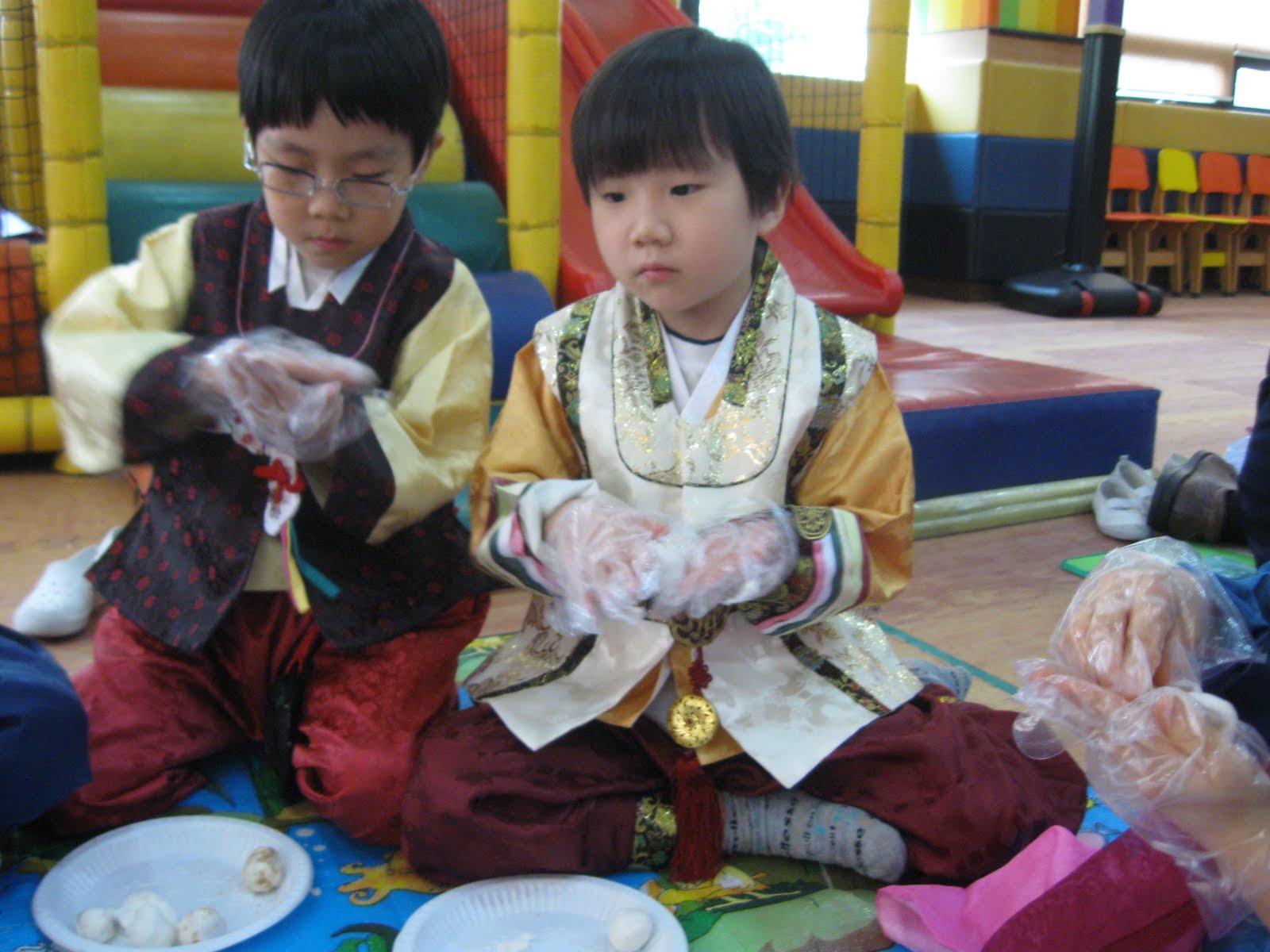
Our school devoted an entire day to our Chuseok celebration before closing for four days (giving me a six day weekend in China). During Chuseok, Koreans wear elaborate traditional outfits called hanboks. Many students wore them for the day's festivities.

The photo above features Lina, Jenna, and Jenny; all girls from the Kindergarten drama class I teach once a week. The women's hanboks are flowing colorful dresses. On my way to Excellence class (my homeroom), I stopped in Dream Class (my support class) to snap some pictures. Ryan and Jack (right) provide an example of what a man's hanbok looks like. Still colorful, but more of a robe. Sally and Adela are on the left.


The first activity planned for the day was making songpyeon, the pumpkin pie of the Korean Thanksgiving. Songpyeon are sweet rice cakes stuffed with sesame. You begin by rolling the dough into a ball. Next, you hollow out the ball into a bowl, fill it with sesame, and seal it up. Naturally, some of the kids were better at this than others. There were some perfectly oblong rice cakes with no filling visible. There were also some mashed up balls where you could hardly differentiate the filling from the cake. After we completed our songpyeon, the cakes were collected, cooked, and returned to the students at the end of the day. Real songpyeon is steamed over pine needles, but I don't know if that's how ours was prepared. Below is a picture of Ian and Henry making songpyeon and a picture of the filled treat before it is sealed up.


After the songpyeon making session it was time for the talent show. I usually decide what my class will do for the talent show, whether it's a song, speech, or play, and spend a week or two before the talent show preparing and practicing. I had no clue what an ideal Chuseok performance would be, so I differed to my Korean partner teacher. She suggested having them write a letter to their ancestors, memorize it, and recite it to the rest of the school. This seemed like a steep task to me. It would involve teaching my kids how to write letters and teaching them the concept of "ancestor." These would probably be difficult concepts for American kindergartners to grasp, let alone those that don't speak English as their first language. I began by drawing a big family tree on the board, ending with the word "you," then branching off to mom, dad, grandma, grandpa, etc. When the tree grew several layers, I circled it all and said, "ancestors." I got a lot of blank stares. This was going to be difficult. After several failed attempts, I realized they would not be able to complete the letter and the rest of the lesson in time. I decided to have my partner teacher explain the assignment to them in Korean the following day, and moved on to the next part of the lesson.

Once the kids understood the assignment, they were able to do a very good job. They all chose to write the letter to a specific ancestor, which made an assignment that may have seemed ambiguous to them more concrete. It was actually very touching to hear all of them read their letters. One student of mine, Henry, had a grandfather who had passed away within the past month. His letter included his memories of his grandfather, like being taken to the barbershop. I almost choked up when he turned in his letter. I was able to get some video of the students giving their performances, but many were difficult to hear. Christine has never had a problem with projection, so I decided to include her performance. She wrote a letter to her great grandmother, who died when she was young.


After the talent show, the ssireum wrestling tournament began, but I already wrote about that in my last post. Ssireum is a tradition during Chuseok as well.


Halloween

Chuseok, with its colorful costumes and ancient rituals, is the quintessential Korean holiday. Halloween, with its costumes and high-fructose-corn-syrup-infused candies , is an uniquely American institution. It was time to hold up my end of the cultural exchange. After a September talent show which emphasized somber reflection and respect for one's ancestors, I decided to lighten the mood in October. Excellence Class wrote a Halloween story, two lines at a time. I wrote the first two sentences, each kid added two lines, then we repeated the process. I gave them some help with syntax, grammar, and word order. The only other guidelines were that we were writing a Halloween story.

We ended up with a powerful saga of good and evil, trials and tribulations. Against staggering odds and countless villains, a hero emerges. Being plot driven more so than character driven, our tale is more of a timeless epic than a modern novel. Without further ado, I give you Excellence Class's Halloween Story.

Eric: Once upon a time there was a man named Eric Teacher (That is what I'm called. Don't ask why, that's just how all the kids address their teachers). It was a spooky Halloween night.

Rena: Eric Teacher was making ghosts by cutting out paper. Some scary bats knocked on the door.

Harry: Eric Teacher opened the door. The bats flew into his house.

Henry: Eric Teacher was scared, so he hid. A monster came in the house too.

Brian: It had three big, green eyes. It had an ugly red nose.

Rodin: A black and red vampire was in the room too. The vampire attacked Eric Teacher.

Christine: The vampire ate the bats. The monster fought the vampire.

Justin: The vampire and the monster died. Eric Teacher ran out of his home.

Ian: A ghost was outside. The ghost threw Eric Teacher's house.

Eena: Eric Teacher's house was gone. The ghost was a monkey ghost.

Rena: The villains shot fire at the world (yes, that's a direct quote). Witches flew in the sky.

Harry: The witches attacked Eric Teacher. Eric Teacher attacked them back.

Henry: Eric Teacher was scared. 100 monsters fought 100 Eric Teachers.

Brian: A tornado blew away the 100 monsters. The 100 Eric Teachers were blown away too.

Rodin: The vampire wasn't dead. The vampire attacked Eric Teacher with lightning.

Christine: Eric Teacher shot fire our of his mouth. The vampire died.

Justin: A girl turned into a ghost. The ghost fought Eric Teacher.

Ian: The ghost won. Eric Teacher was hurt.

Eena: Eric Teacher shot laser out of his mouth. The ghost flew away.

The End.

Each kid read his or her lines for our talent show performance. It was riveting. While he is able to fend of monsters and shoot fire out of his mouth, Eric Teacher was unable to remember the camera on Halloween. The kids came in costumes, we did Halloween activities, and we trick-or-treated quickly.

Thanksgiving

I'll keep this one brief since we didn't celebrate the holiday in school. If you want to celebrate Thanksgiving in Korea, you really have to seek it out. Several bars in Itaewon (the foreigners neighborhood) offered buffets on Thursday, and we hit up one of those. There is a Costco several bus stops from where we live that sold pumpkin pies, so I bought a few throughout the course of November. On Saturday, one of the other teachers hosted a potluck, which featured some tasty food. About the only thing missing was the chance to watch the annual sacrificing of the Lions at Ford Field. At least Tom Brady got to pad his stats.

Many more posts to come (including one about vacation), but I am incredibly busy right now. Hope everyone had a wonderful holiday season.

Wednesday, November 24, 2010

Update

I know all of you that watch the news may be worried about me, but I am doing just fine. The North Korean attack was on an island along the desputed border between North and South Korea. The island consisted of a small population of fishermen and soldiers (about 1300). I am registered with the US State Department, and receive security updates through e-mail. If the conflict were to escalate, the State Department and US Military would help all US citizens evacuate. Such an escalation is very unlikely at this point, but if it happens I will be on my way home.

Monday, November 8, 2010

March Madness in September

Quick note: These events happened almost two months ago during our Chuseok celebration, right before I left for China. Had it not been for the amazing six days in China that I have devoted the last three posts to, I would have reported on this much sooner. I will tell you more about the holiday of Chuseok in my next post.

Now for this post....

Sports capture the very essence of what means is to be human. We thrive on the heart-pounding excitement of competition. Players and fans endure the emotional roller coaster through the elation of victory and the soul-crushing devastation of defeat. We love the narrative that sports provide: the comebacks, the vilified odds-on-favorites, the blue collar underdogs, the idea that if you just work hard enough you can succeed at anything. I have witnessed many great moments in sports history: I lived through the Jordan Era in the NBA, watched homeruns turn players to heroes only to have performance enhancing drugs turn them into villains a few short years later, watched the Patriots go from everyone's favorite underdog in 2002 to losing their perfect season in the Super Bowl in 2008. I saw my favorite hockey team end a 42 year Stanley Cup drought in 1997, and watched the Wolverines knock off #1 Ohio State in 1996 and go on to win a National Championship the following year. And now I submit another chapter to the great moments in sports history: The 2010 GDA Junior Chuseok Ssireum Wrestling Tournament.

As with every other great sports story, there is a back story that allows one to fully appreciate the events they witness. I will being with the back story. Ssireum Wrestling is the Korean equivalent of sumo. The two competitors grasp each other by the waist belt and try to use their strength and leg maneuvering to topple their opponent to the ground. Victory is achieved when any part of your opponent above his knee hits the ground. The other part of the back story is that Koreans are crazy competitive. In America everyone gets a trophy; in Korea we have spelling bee champions, running champions, and wrestling champions...in kindergarten. My kids argue over who gets to pass out the most books, so you can imagine what it's like when the competition is official.

I was teaching one day in my support class (Dream) when Jack excitedly exclaimed that he was the class wrestling champion. Jack regularly informs me of his accomplishments in gym class (or in anything else for that matter), so at the time I responded "Wow! Good job, Jack," and continued teaching my lesson. Jack reminded me of his status as class champion the next day, and the next. Maybe this was more important than a simple game to kill time in gym class. Then, during my gym break (I get three gym breaks every two weeks where the gym teacher teaches my kids) I walked by the gym to see my homeroom kids (Excellence) wrestling. My cute little kindergartners with their jaws clenched, locked in opposition. It was hilarious. I could not stop watching. When I was in kindergarten, we played with giant colorful parachutes in gym; in Korea, they fight to the death. I asked the director what all the wrestling was about, and she explained that the school was going to have a tournament during the Chuseok celebration. Each class would send its top two wrestlers to the tournament to compete for intraschool dominance.

Quarter Finals

The day of the tournament, the wipe board in the gym had two NCAA-style March Madness brackets drawn up, one for the five and six year olds (in Korea when you're born you're 1, then on New Year's Day everyone turns a year older, so the five and six year olds are anywhere from three to five) and one for the seven year olds. From my homeroom class Eena and Rodin made it in to the tournament, and from my support class Jack and Tristen were through. Eena was a bit of a surprise; she loves all things pink and beautiful, but she can be feisty when she needs to be. Given that this was a kindergarten competition just for fun, I did nothing to over-hype the event or get my kids riled up. I was a detached observer with no clear bias toward the kids in my classes.


The AWWWWWW was because I thought Eena hit first, but she didn't, and she advanced to the semifinal. In fact, all four kids from my homeroom class (Excellence) and my support class (Dream) advanced. Both semifinals consisted of entirely kids that I taught.

Semifinals

I felt like a mother does when her son competes against a nephew. You want both to do well, but clearly you want your own child to win. In this semifinal, Rodin does just that.


Rodin's tactics feature using upper body strength to overpower his opponents. This worked well against the long and lanky Tristen, who had a high center of gravity. In the other semi-final, Jack took care of Eena with ease, setting up a Dream v. Excellence final for the ages.

The Championship

The excitement began to mount as the clear-cut top two performers entered the ring. Rodin against Jack. Both students of mine. Both had clearly learned from their teacher, and now sought to make a name for themselves in sporting history.


After a hard fought 23 second battle, the official blew the whistle. I couldn't figure out what had happened. It didn't appear that either wrestler had emerged victorious to me...and then I noticed the blood oozing out of Jack's nose. The match had to be stopped. The injured wrestler was removed from the ring and bandaged up. Would Jack be able to return from injury and challenge for the crown, or would Rodin win on a technicality? In the meantime, the five and six year old final took place while Jack was being tended to, and the whole arena (okay, gym) waited with baited breath to see what would happen next.


Jack was in tears, agonizing over the thought that injuries might prevent him from claiming what he believed to be his. I wanted Rodin (from my homeroom) to win, but not like this. GDA needed to have a true wrestling champion, and it had to be decided in the ring. Following the crowning of the five and six year old champion, Jack wiped away his tears and prepared to do battle once more. He was a tenacious foe for Rodin. One to be respected, admired.

Rodin's best asset as a wrestler is his strength to weight ratio. He may be skinny, but he is extremely strong as he demonstrated against Tristen, pinning him to the ground with sheer brute force. Jack would prove a trickier opponent. Jack is dense and short, with a lower center of gravity. On top of that, Jack has mastered the footwork and the ability to hook is opponent with his leg, then go for the kill.


That move proved to be Rodin's downfall. After avoiding several of Jack's early attempts, Rodin was finally hooked and taken down. It was a bittersweet moment for me, as I had strong connections to both athletes. My horse lost the race, but Jack clearly deserved the win. He battled back against all odds, through trials and tribulations.

It was now time for the presentation of the medals:


Clearly Jack was still writhing in pain, as he was unable to muster a smile for the championship photo. This demonstrates how truly Herculean his victory was. Rodin and Tristen tried to be content with second and third places, but the pain for them was emotional. Jack was excited about his victory, he was just too exhausted to show it that day. I know this because following the tournament, Jack reminded everyone in his class that he was the wrestling champion. When we learned about adjectives that compare, Jack informed the class that he was strongest because he was the wrestling champion.